
Every small-home dweller eventually asks the same question: is there a better way to dry clothes than the giant rack in the middle of the floor? There is — but the right choice depends on your walls, your lease and how much laundry you do. Here is a clear look at the four main options.
The quick answer
A floor rack is cheap and flexible but clutters the room. A drilled wall rack saves space but means holes and a deposit risk. A retractable clothesline is slim but bunches clothes together. A no-drill, suction-mounted wall rack gives you wall-rack space savings without the drill — the best fit for most renters.
Folding floor drying rack: easy, but always in the way
The classic X-frame rack needs no installation and holds a full load. The problem is everything else: it blocks a walkway or a corner for a day or two, it wobbles, and it has to be folded and stashed behind a door afterward. In a studio or one-bedroom, it often becomes a semi-permanent piece of furniture.
Drilled wall-mounted rack: tidy, but a commitment
A rack screwed into the wall folds flat and frees up the floor — a big upgrade. But installation means a drill, wall anchors, finding the right spot on the first try, and holes that stay when you move. If you rent, it may simply not be allowed.
Retractable clothesline: slim, but crowded
A pull-out line disappears into a small box on the wall, but clothes hang shoulder-to-shoulder on a single line, which slows drying. It also needs two anchor points and usually screws.
No-drill suction wall rack: the renter-friendly middle ground
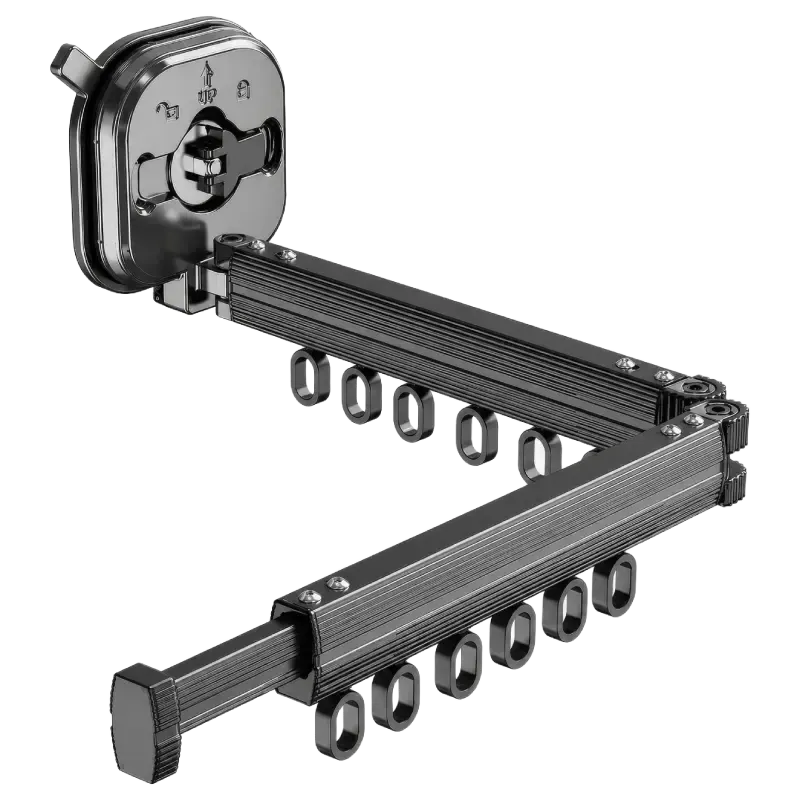
A suction-mounted rack attaches with a vacuum seal instead of screws. You get the main benefits of a wall rack — no floor space, folds flat, laundry in one spot — and you can take it down or move it in seconds, leaving no marks. The one requirement: a smooth, non-porous surface like tile or glass.
Side-by-side comparison
| Factor | No-drill suction rack | Floor rack | Drilled wall rack | Retractable line |
|---|---|---|---|---|
| Floor space | None | A lot | None | None |
| Installation | Seconds, no tools | None | Drill & anchors | Screws, 2 points |
| Holes in walls | No | No | Yes | Usually |
| Folds away | Flat on the wall | Must be stored | Flat on the wall | Retracts |
| Clothes spacing | Sliding hooks | Good | Good | Crowded |
| Moves with you | Yes | Yes | No | No |
Our pick for most small homes
If you have tile or glass where you would like to dry clothes, a no-drill wall rack is the clear winner. The one we recommend is the Qinux Hangeroox: a powerful vacuum suction cup, corrosion-resistant aluminum arms that extend up to 10 inches and rotate 180° and 360°, sliding hooks for even drying, and a design that folds flat against the wall. Owners rate it 4.8/5 on the official site.
Frequently asked questions
Are wall-mounted drying racks worth it?
For small homes, yes. They use zero floor space, fold away when not in use and keep laundry in one tidy spot. The main downside of traditional models is drilling; no-drill suction models remove that problem on smooth surfaces.
Can I install a wall drying rack without drilling?
Yes. Suction-mounted racks attach with a vacuum seal on smooth, non-porous surfaces like tile and glass. Adhesive options exist too, but they are harder to remove cleanly and can’t be repositioned.
What is the best drying rack for renters?
One that leaves no trace: a floor rack or a no-drill suction wall rack. The suction option saves far more space and can move with you to your next apartment.